


Written by: ST DIGITAL, CABINET-TF
An internet address or domain name is the equivalent of your postal address on the internet. It is through your domain name that your contacts will reach you online. A domain name is therefore essential when creating your website.
While a domain name is indispensable, the choice of that domain name is very important, as a good domain name promotes better visibility in search engines, attracts potential visitors and helps drive traffic to the site.
We have compiled some practical tips for you to follow when registering your domain name.
Registering a domain name: what should you pay attention to?
Whether it is an online store, a blog, a private website or a web project, it is very important to choose the right domain name. It consists of the top-level domain (TLD), i.e. the extension .cm, .ci, .tg or .com, and the second-level domain.
Creating your own domain name presents no difficulty; for example, in Cameroun, you can check its availability with any provider, also known as a registrar. The latter will subsequently contact a specialised organisation (registrar) responsible for the desired TLD. ANTIC handles, for example, .cm domains, while Internic manages .com domains.
A domain name is unique within a namespace (such as .cm, .int, .org…) and assigned on a first-come, first-served basis, provided the applicant meets the conditions for the extension. Registrars and specialized organizations carry out all necessary checks for this purpose.
Before registering a domain name, it is therefore recommended that the user verify whether or not other potential sources of conflict with their project exist. Indeed, the domain name and the trademark are marketing tools that contribute to the company's visibility and customer loyalty. However, these are two distinct intangible assets; a trademark is an industrial property title, which is not the case for a domain name. A trademark is characterised by its distinctiveness, which is not mandatory for a domain name.
One of the mistakes frequently made by entrepreneurs is to address these issues separately. It is important to establish once and for all that a brand and a domain name constitute a winning combination for companies wishing to achieve international visibility or seeking to develop their activities across multiple territories. In this case, to avoid developing another brand or reserving another domain name, it is recommended to verify the availability of these assets upstream and then reserve them before another party becomes interested.
Structure of a domain name
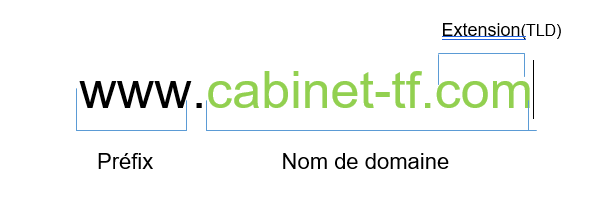
Some Essential Tips for a Good Domain Name:
- Choose the right domain extension;
- Ensure that your domain name is simple and short;
- Use only letters for the domain name;
- Avoid brand names ;
- Incorporate your brand as needed;
- Incorporate relevant keywords.
How to adequately choose the top-level domain? How to choose the second-level domain without infringing trademark rights?
The choice of Top Level Domain
The top-level domain (TLD) represents the highest level of name resolution and is always located at the end of the name, to the right of the dot. The most popular domain extensions are currently: .com, .net, .org, as well as country-level ones such as .cm or .ga. The following are distinguished:
Generic TLDs: these refer to the nature of websites. For example, a .com extension indicates a commercial offering, while .org corresponds to organisations, associations, and NGOs.
Country-specific top-level domains indicate the origin of a website. Each country generally has a two-letter code. For example, .tg corresponds to Togo, .ga to Gabon, and .ma to Morocco.
We recommend securing several extensions and domain names. It is possible, through cost-effective solutions, to register a name with multiple TLDs. These packages offered by providers help improve the visibility of your website and protect your domain variants from malicious activities.
The new TLDs
New top-level domain extensions are part of generic TLDs and have been permitted since 2013. They allow the creation of highly specific names and give users indications about the page they are visiting. The possibilities are numerous: commercial terms such as .shop, .business, as well as those indicating a city name. We can cite the example of .paris or .toulouse. When the desired name is already associated with a common TLD, these new generic names serve as a good alternative and allow the chosen terms to be retained in the domain name.
Domain name and trademark law
Imagine you wish to register the domain name ''AURANGE.cm'', which is quite similar to the registered trademark ORANGE, this reservation is potentially conflict-generating with respect to the ORANGE trademark.
The prior existence of a trademark can constitute the basis for opposing the registration of a domain name identical or similar to the earlier trademark
To avoid any disputes, it is recommended to register and use a domain name that does not infringe the prior rights of a third party. In addition to checking the availability of the domain name, be sure to conduct a trademark priority search to verify that the requested name is free for use and that you are therefore not exposed to potential legal action.
Please note that trademark rights are acquired through registration under the principle of prior use — in other words, if you use a trademark without having registered it, you do not hold the exclusive right to exploit it.
There is also in trademark law the principle of speciality, which consists in considering that the rights to a trademark are acquired solely for the products and/or services for which said rights were requested, as well as for any similar product or service.
Is there an exception to the principle of speciality?
To this question, we would answer in the affirmative. Indeed, if the prior trademark enjoys strong notoriety, the principle of speciality will not apply. Thus, the registration of a domain name TAUYAUTA.com for automobile manufacturing or any other activity may constitute infringement, and the trademark holder may also seek the conviction of the person implicated on the grounds of parasitic competition.
Can the prior reservation and use of a domain name constitute the basis for an unfair competition claim?
The answer is YES. According to the OAPI intellectual property code, any act of unfair competition, that is to say, any practice which in the exercise of an industrial or commercial activity creates or is likely to create confusion (in relation to any distinctive sign, here the domain name), with another party's business, is punishable by damages that take into account the loss of earnings, the profits made by the author of the unlawful act, and any moral prejudice where applicable.
What about domain names that are reserved but not in use?
In practice, it is common to reserve a domain name while awaiting the launch of a company's activities. However, caution should be exercised with this practice, as case law considers that the protection of a domain name only begins from the date of its actual use. In other words, a domain name reserved for future use is at risk of having its reservation challenged by a third party who can prove prior use of a similar name in the same field. In order to strengthen the protection of your domain name and therefore your brand image, it is recommended to register your domain name as a trademark with an industrial property office, provided that the said name meets the conditions for trademark registration.
Trademark registration requirements
- Visible or audible sign used in commerce (words, names, drawings, logos, three-dimensional signs, audiovisual signs, serial signs, sound signs);
- Distinctive sign, meaning it does not constitute the generic designation of the product;
- Available sign, meaning it does not infringe upon the prior rights of a third party;
- Sign not contrary to public order and morality in accordance with the regulations applicable in the designated country;
- Sign that does not include among its elements the coat of arms, flags or emblems of a State.