









Monday, 8:30 AM. Your core banking system has just crashed. 150 branches paralyzed. Thousands of customers blocked. And you, CIO of a major Ivorian bank, are desperately trying to reach someone to restart your servers hosted in that makeshift "datacenter" in the basement of your head office.
Does this scene seem familiar? You are not alone. In Côte d'Ivoire, 73% of financial institutions still host their critical data in non-certified internal infrastructure, according to our 2026 market analysis.
In this article, you will discover why datacenter colocation is no longer an option, but a regulatory and operational necessity for your financial institution.
What is datacenter colocation and why now?
The precise definition
Datacenter colocation consists of hosting your servers in a specialised third-party datacenter, while retaining full ownership and control of your equipment and data. Unlike public cloud, your physical servers belong to you. Unlike in-house hosting, the infrastructure (power, cooling, security, connectivity) is managed by experts.
For an Ivorian bank, this concretely means:
- • Vos serveurs core banking restent vos serveurs
- • Vos données ne sortent jamais de Côte d'Ivoire
- • L'infrastructure est certifiée aux standards internationaux
- • Le support technique est disponible 24/7
Why 2026 is the pivotal year
Three major developments make colocation indispensable:
1. WAEMU Regulatory Tightening
The UEMOA Banking Commission strengthened its requirements on business continuity plans (BCP) in 2025. Audits now systematically verify:
- • La redondance des systèmes critiques
- • La certification de l'infrastructure d'hébergement
- • La documentation des procédures de reprise d'activité
2. Explosion of cyber threats
Attacks against African financial institutions increased by 340% between 2023 and 2025. The average cost of a cyberattack on a regional bank? 2.8 billion FCFA, according to the PwC Cyber Africa 2025 report.
3. Pressure on IT costs
Maintaining an internal datacenter costs on average 40% more than colocation, when all hidden costs are factored in: specialized staff, preventive maintenance, technology upgrades, insurance.
The 7 Essential Criteria for Choosing Your Colocation Partner
1. Specialized Banking Certifications
PCI-DSS (Payment Card Industry Data Security Standard)
Mandatory if you process card payments. This certification ensures that the infrastructure meets the 12 fundamental security requirements for payment data.
ISO 27001 — Information Security Management
The international reference standard. It covers 114 security controls across 14 domains. For a bank, it is the assurance that your partner has mastered security governance.
UEMOA Banking Commission Compliance
An African specificity often overlooked: your datacenter must comply with the Banking Commission's guidelines on the outsourcing of banking activities. Few providers truly master this.
2. Tier Certification Level
Tier III — 99.982% Availability
The minimum acceptable for a financial institution. This corresponds to a maximum of 1h40 of downtime per year. In practice:
- • Redondance complète (N+1) sur tous les équipements critiques
- • Maintenance sans interruption de service
- • Délai de récupération (RTO) inférieur à 4 heures
Beware of fake "Tier III" — Many data centres self-proclaim "Tier III" without official certification from the Uptime Institute. Demand the certificate.
3. Localisation and Sovereignty
In Abidjan, prioritize : the Plateau/Cocody area for its proximity to the business district, secure road access 24/7, distance from flood-prone zones, and direct connection to submarine cables (ACE, MainOne).
Your datacenter must contractually guarantee that your data never leaves Ivorian territory, is accessible only to your authorised personnel, and complies with the forthcoming Ivorian law on personal data.
4. Multi-Operator Connectivity
An Orange outage must not bring your bank to a standstill. Your datacenter must have a minimum of 3 different ISPs (Orange, MTN, Moov), redundant connections over separate physical routes, and scalable bandwidth without service interruption.
5. Multi-Layered Physical Security
Biometric access control: only authorised members of your IT team can access your servers. 24/7 monitoring: cameras, detectors, security patrols. In the event of an intrusion, you must be alerted immediately.
6. Precise Contractual SLAs
- • Disponibilité garantie : 99,982% minimum avec pénalités financières en cas de non-respect
- • Incident critique (panne totale) : Réponse < 15 minutes
- • Incident majeur (dégradation) : Réponse < 1 heure
- • Maintenance programmée : Préavis minimum 72h, fenêtre hors heures d'ouverture bancaire
7. Local Technical Support
On-site team 24/7: in the event of a problem at 2 a.m., someone must be able to intervene physically on your servers. Your partner must train your teams on the infrastructure and emergency procedures.
Colocation vs Alternatives : The Decision Matrix
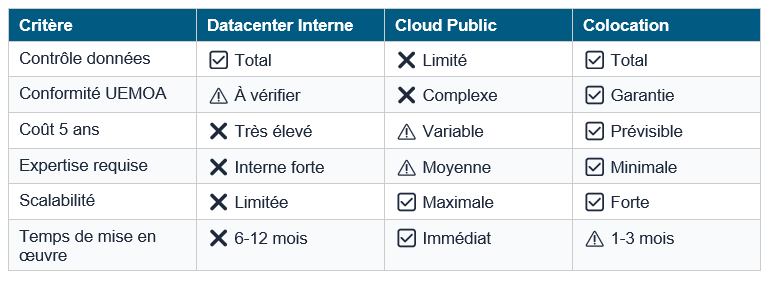
The True Cost: TCO In-House Datacenter vs Colocation
Internal Datacenter — Hidden Costs
Initial CAPEX (first year): Servers and storage 50M FCFA + Network infrastructure 15M FCFA + Air conditioning/UPS 25M FCFA + Physical security 10M FCFA = Total CAPEX 100M FCFA
Annual OPEX : Dedicated IT staff 36M FCFA + Electricity 18M FCFA + Maintenance 8M FCFA + Insurance 6M FCFA + Upgrades 12M FCFA = Total OPEX 80M FCFA/year
5-year TCO: 100M + (80M × 5) = 500M FCFA
Colocation — Realistic Cost
Initial CAPEX: Servers only 50M FCFA + Migration and setup 5M FCFA = Total CAPEX 55M FCFA
Annual OPEX : Colocation (4 racks) 24M FCFA + Reduced staff 18M FCFA + Bandwidth 6M FCFA = Total OPEX 48M FCFA/year
5-year TCO: 55M + (48M × 5) = 295M FCFA
|
Savings achieved: 205M FCFA over 5 years, representing a 41% reduction |
The 5 Fatal Mistakes to Avoid
• 1. Choisir sur le Prix Uniquement : Le moins-disant n'est jamais le bon choix. Un datacenter 30% moins cher sans certifications vous coûtera 10 fois plus en cas d'incident majeur.
• 2. Négliger la Visite Physique : Visitez impérativement le datacenter avant signature. Vérifiez la propreté, l'organisation des câbles, la documentation des procédures.
• 3. Sous-estimer la Migration : Migrer un core banking prend 3 à 6 mois de préparation. Planifiez les fenêtres de bascule en dehors des pics d'activité (évitez fin de mois).
• 4. Oublier la Formation Équipes : Vos équipes IT doivent maîtriser les nouvelles procédures. Exigez une formation complète de votre partenaire.
• 5. Négliger la Documentation : Tous les processus, accès, contacts d'urgence doivent être documentés et régulièrement mis à jour.
Roadmap: The 8 Steps of a Successful Colocation Project
Phase 1: Audit and Planning (Weeks 1-4)
1. Audit existing infrastructure
2. Definition of precise technical requirements
3. Shortlist of qualified providers
4. Datacenter visits and benchmarking
Phase 2: Selection and Contracting (Weeks 5-8)
5. Contractual negotiation and SLA
6. Legal validation and compliance
Phase 3: Implementation (Weeks 9-20)
7. Migration preparation and testing
8. Cutover and production deployment
Total duration: 4 to 6 months for a complete project.
The time for strategic choices
In 2026, maintaining an uncertified in-house datacenter exposes your financial institution to major risks: regulatory (UEMOA non-compliance), operational (critical unavailability), financial (hidden cost overruns), and reputational (client impact in the event of an incident).
Colocation is no longer a technical matter — it is a business imperative. Financial institutions that delay taking the step are taking a competitive risk. Those who prepare now are gaining a head start.
Are you truly ready for your next Banking Commission audit?
|
Next step : Download our "Survivor Guide: Being an IT Manager in a Financial Institution in Africa" — Le guide complet pour anticiper les 8 scénarios critiques qui peuvent paralyser votre banque. |