

- In Cameroun, attacks exploiting security vulnerabilities (exploits) nearly doubled between 2023 (174,472) and 2024 (333,930), representing an increase of +91%.
- This increase is attributed to infrastructures that are often outdated or poorly maintained, and to a lack of awareness within public and private organisations.
- In Chad,
the government joined in September 2024 the International Counter
Ransomware Initiative, committing alongside more than 70 countries in the
fight against these threats.
This movement strengthens the protection capabilities of public administrations and critical infrastructure, through international cooperation. - In the Central African Republic (CAR), a national law on cybersecurity and cybercrime was adopted in January 2024, establishing a National Cybersecurity Agency responsible for regulating, detecting and responding to cyber threats.
🔍 Local initiatives and innovations
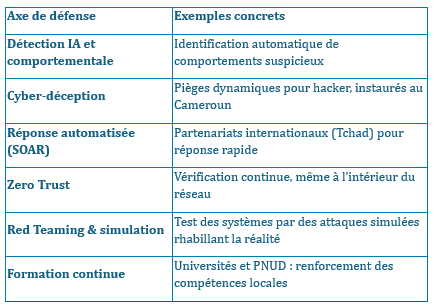
- University of Dschang (Cameroun) : two theses defended in February and April 2025 introduce cyber-deception approaches – systems that deceive hackers, slow down attacks, and collect data on malicious behaviours, particularly against banking infrastructures and connected devices (IoT).
- UNDP Central Africa
Programme (October 2024): offers cybersecurity training for young leaders, focusing particularly on fintech,
data and digital governance.
A key project to strengthen local skills and bridge the gap in qualified professionals.
Technologies & strategies adopted in 2025
Legal Framework and Regional Cooperation
- Malabo Convention (AU) : entered into force in June 2023, it establishes a common legal framework for cybersecurity and data protection in 16 African countries.
- National initiatives are multiplying: following the CAR, other ECCAS member states are accelerating their legislative and organizational frameworks, with support from regional and international institutions.
Three priorities for Central Africa
- Strengthening infrastructure : modernising systems and performing regular updates.
- Developing human capital : university training, UNDP programmes, international partnerships.
- Consolidating legislation and cooperation : legal framework (Malabo, national laws) and participation in global initiatives (against ransomware).
Cybersecurity in Central Africa is no longer merely a technical matter, but a strategic, human, and regulatory challenge. Among:
- rising threats (exploits, ransomware),
- innovative local responses (cyber-deception, training, legal action),
- and integration into continental dynamics (Malabo, AU, UNDP),
a genuine rise in prominence of the region is being observed.
Need support? We can:
- Conduct a comprehensive security audit (exploits, ransomware, IoT);
- Offer training tailored to your specific context.