








"Supporting companies in their transformations". ST Digital has made this one of the essential drivers of its business by helping several companies in West and Central Africa to implement digital strategies. An overview of the key success factors of a transformation roadmap.
"How can I transition from my current legacy state to a competitive digital enterprise capable of driving growth and creating new economic value?" This is one of the questions most of our clients in Central and West Africa ask themselves. Today, our clients recognise that digital technologies are fundamentally transforming the way they operate, serve customers and citizens, and can drive their business forward.
Digital transformation targets all aspects of the organisation, including the business model, leadership and management, culture and organisation, data, marketing and customer experience, human capital management strategy, the operating model, technology, as well as skills and talent, with the aim of creating an organisation that integrates digital and is capable of developing innovative ways to operate, evolve and grow its activities. When carried out within the framework of an overall strategy rather than one-off projects, digital transformation can help you improve your competitiveness in the digital world.
· Optimization of the return on capital invested in your products and services
· Improvement of operations and cost reduction
· Improvement of customer, citizen and employee experience
· Development of a proactive cybersecurity strategy and transformation of security into a differentiating factor
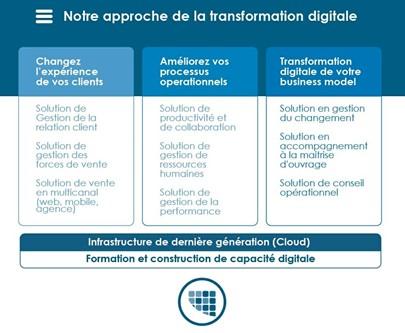
To leverage these advantages, a clear strategy and roadmap addressing both existing and digital technology and processes are required to generate value, produce actionable insights and focus on customers. ST Digital can help you increase the value of your organisation through the development of a digital strategy and roadmap, and set you on the right path to deeply transform your business.
Defining a roadmap: the 5 steps to success
1- Prepare yourself
"If you always do what you have always done, you will always get what you have always got," Albert Einstein tells us. First and foremost, it is necessary to update your knowledge of digital. Before launching a transformation process, it is therefore important to ensure that your expertise and that of the departments involved in your company are brought up to speed. It is also important to understand the company's business, and to ensure the identification of current and future challenges. This monitoring and these various exchanges should already help you identify the most obvious threats and opportunities that you can discuss.
2- Audit
Once your mission has begun, it will be necessary to quickly compare your vision against a reality assessment.
Survey management, employees, and service providers at all levels. Conduct a performance audit against the competition. Take advantage of your fresh perspective to objectively compare the strengths and weaknesses of your offering against that of the competition. Carry out your SWOT analysis to identify opportunities and threats to the existing offering.
3- Plan and frame
This is about defining a clear strategy for digital transformation. Transformation, yes — but toward what objectives? With what resources? Within what timeframe? A roadmap should help you concretely formalise the vision to follow. This vision must be presented to each decision-maker to ensure not only their input, but above all their involvement and support.
4- Test
"If we wait until we are ready, we will be waiting for the rest of our lives," said Lemony Snicket. Once the milestones have been set, the time has come to test. In order to limit anxiety and risk, an experimentation phase is particularly recommended to refine your project and anticipate potential obstacles to its deployment. Communicate your strategy internally and sometimes externally as well. Begin with an experimentation phase. Implement measures to support change management. As testing progresses, pressing needs will emerge. Change management support will be essential to keep operations running smoothly and minimise friction. This encompasses management backing as well as staff training.
5- Deploy, measure and optimise
Transformation is an iterative process. Once your projects are launched, the time comes for monitoring and optimisation. "Progress always has progress to make."
Measuring performance and return on investment (ROI) of actions taken.
Amplify, correct, or stop what is not working.
Communicate and celebrate "quick wins".
ST Digital is a pan-African Digital Services Company established in Central and West Africa. We make digital transformation consulting one of our core drivers.
Key References
Togolaise Des Eaux – Togo
Brasseries du Cameroun – Cameroun
Ogar Assurances – Gabon
Cgnamgs – Gabon
Camtel – Cameroun
Crtv – Cameroun